Author: Yvonne Feresu

  • Why the creative personality must create or die

    Why the creative personality must create or die

    I came across a nugget of information on a very dark day that changed everything. To be honest this information should have been very obvious to me considering my own experiences and my background in Psychology. Suffice to say part of me did know but I thought they were just flights of fancy on my end. So what the hell was this information?

    People with highly creative personalities have no choice but to create.Dr Jordan Peterson

    To not create is to die a slow spiritual death. It takes a massive toll on your being as a creative individual to not practice your art or your craft. But often a lot of us who are not earning directly from our craft sometimes sideline it to the detriment of our well-being.

    You will note that I used the word ‘personality’ earlier on, and that’s because creativity is as much a result of personality as it is the environment. In other words, it’s encoded in your DNA because personality is widely believed to have a biological basis.

    (PS: I will be leaving links to detailed, but easy to understand articles on this topic for you to sink your teeth into. Psychology is very broad and sometimes complex or confusing therefore I will point you in the right direction.)

    What is personality?

    A simple, easy to understand definition is: Personality refers to individual differences in characteristic patterns of thinking, feeling and behaving (apa.org). Personality encompasses all the traits, characteristics, and behaviours that set you apart from everyone else.

    This is of course the simple definition. Once you dive into the world of research psychology it becomes much more complex. For today that explanation will suffice. Creative individuals usually share a particular core personality trait that makes them who they are. That trait is openness, one of the Big Five.

    The five-factor personality theory

    The five-factor personality theory, also commonly known as the Big Five theory is a widely accepted framework used to describe and test the human personality. There are many theories on personality, but the Big Five is the most widely agreed upon in the field of Psychology.

    It breaks personality into 5 core traits that are universal, namely; openness, conscientiousness, extraversion (also spelt extroversion), agreeableness and neuroticism. For the sake of this discussion, we’ll only touch on openness. You can read this article on the subject for more information on the other traits. It’s easy to understand and well laid out.
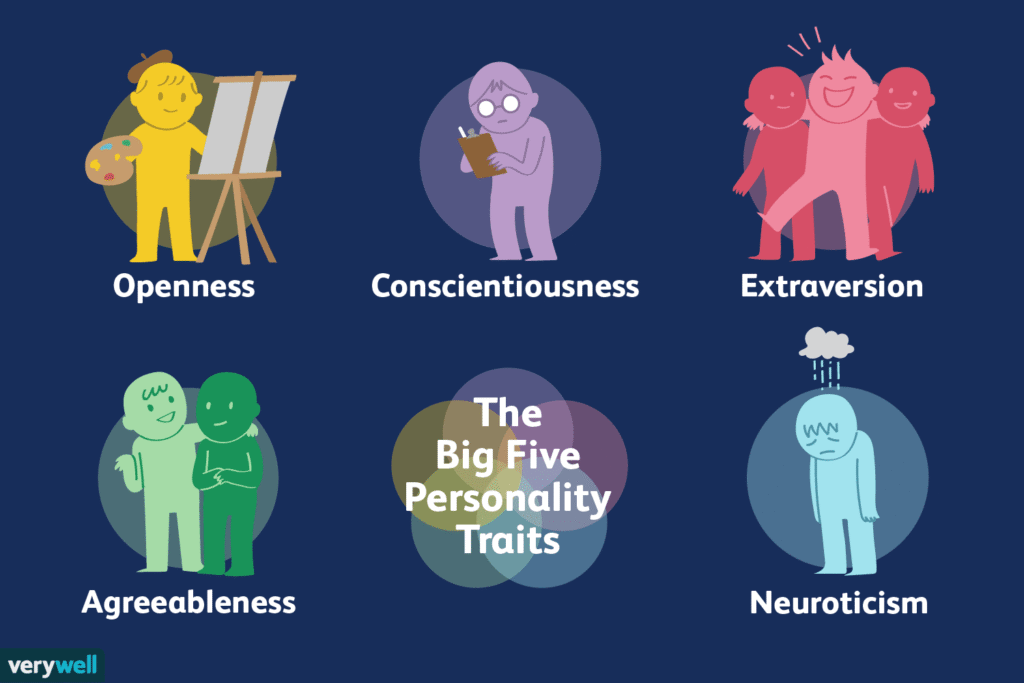
    Image credit: verywellmind.com

    It’s necessary to point out that these traits happen on a spectrum between two extremes. Imagine a line graph from one to 100 as the spectrum, and people will fall anywhere between those values. So basically everyone has these traits but within a range from high to low. Creative personalities are often high in openness.

    Openness and the creative personality

    So, what is openness?

    In short – the tendency to be intellectually curious and use imagination.

    People high in this tend to be creative, adventurous, have many interests, love learning and new experiences. They often think outside the box, crave novelty, enjoy the arts and engage in creative careers or hobbies. Now, do you see why most creative people share this same personality trait?

    Despite having studied Psychology, I never applied this knowledge to myself. This was unusual for me because I’m very self-aware and do a lot of introspection. I partly blame the lack of insight on my former dislike for the subject, the module on Personality was one of my least favourites. I digress. My point is when you are high in openness as a creative person, not engaging in your art means going against your biology. It will leave you miserable. I learnt this the hard way when I gave up creative writing for financial freedom.

    So why do we stop creating?

    There are many reasons creative people ignore that aspect of their personality once they become adults. One of the most common though is money. Following a creative endeavour simply doesn’t pay the bills for a lot of people. Monetizing that passion is extremely difficult and the market for your endeavours might not be lucrative. There is a myriad of other, often traditional careers that will almost guarantee you a steady income and more often than not, a creative career isn’t one of them.

    For those of us that do have successful creative careers, it’s a long and slow process and we shouldn’t expect overnight success. Most of us will give up on these in favour of more stable jobs, but that’s still okay. What matters is you create regardless of whether that earns you an income or not.

    So what happens when you don’t create?

    Misery, sadness, a feeling of incompleteness. I can only speak from my own experience here and tell you how that was like for me. I felt as if I was suffocating slowly, with this widening emptiness I couldn’t fill. Whenever I create I experience this buzz of energy, I feel alive. When I live through long spans of time without creating anything, I feel this bone-deep sadness that I cannot shake. I ask myself what the point of life is, I start to have mental breakdowns. This is not melodrama, when I said I made my discovery during a dark time, I wasn’t exaggerating.

    So how can we always ensure that we create? How do we keep that creative personality from withering inside?

    How to have your cake and eat it

    Well there are many routes, but these three are the most obvious:

    • Attempt to establish a creative career that fully supports you financially. I’ll admit, this is pretty difficult for most people but if you have very few financial responsibilities and the time, give it a shot.
    • Get a creative job for your 9-5. The creative industry is booming with the need for copywriters, designers (web, graphic, UX etc), illustrators and so many more. The list is very long. This might work for you, satisfying the need to create, but often you might not control the artistic vision or direction which might drive you crazy. Your own little hobby will still be necessary.
    • Getting a relatively undemanding 9-5 and becoming a serious hobbyist for your craft. This I would say is the best alternative. By undemanding job, I mean the kind of job that doesn’t require you to work crazy hours or leaves you feeling mentally and emotionally drained. That leaves you time and energy to invest quite seriously in your hobby. Purchase the tools you need, dedicate time for it, create and share your work. Do this to feed your spirit, keep it alive and help it thrive.

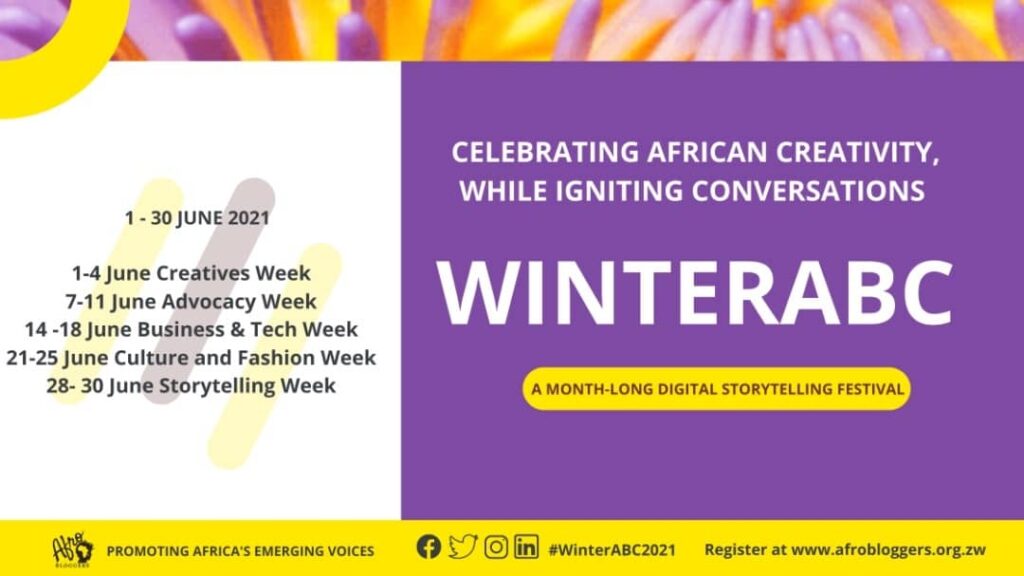
    So there you have it – why not creating leaves you feeling miserable and what to do about it. As for myself, I’m still trying to find my way but I have learnt my lesson, never stop creating. This post is part of my participation in the Afrobloggers #WinterABC blogging challenge.

    For further readings on personality and the Big Five, PositivePsychology.com has the perfect article for you, follow that link to read it. It will give you more background on personality, a brief history and interesting cases that happened in the field. It’s detailed but easy to follow and won’t drown you in too much information.


  • The Creative Career: Why do we want overnight success?

    The Creative Career: Why do we want overnight success?

    Dear creatives, when did we become enamoured by the idea of quick, overnight successful creative career? We want it all, and we want it fast. We compare ourselves to the girl who went viral on Tiktok or the guy who built a multi-million dollar app in two years or the other girl who built an empire using Instagram. It boggles our minds why that person couldn’t be us. Why despite uploading video after video of what we deem comedic excellence we never took off yet Elsa Majimbo caught fire and was now on the cover of Forbes?

    We see other young people taking seemingly lavish vacations (mostly before the pandemic) and we want it all so badly, and we want it soon. We want to take a fully funded retreat to just create in luxury! Those of us living in failed states, and struggling economies envy the “ease” at which our peers in developed countries seem to acquire what they want. Their creative industries are better and bigger. We see our peers in magazines, winning awards…or just frankly winning.

    We want to be the next John Boyega or Tomi Adeyemi or the next whoever seems to have made it in life. There are a plethora of young, rich celebs (or richer than us at least) both local and international. They made it, we haven’t. We want to be exceptional too.

    But here’s the thing…it doesn’t happen like that for most of us. It didn’t even happen like that for the multitudes of people with successful careers both in developed countries and here (the other half of the world). Creative industries everywhere are brutal, and following a creative career is often a high-risk endeavour.

    Career success is often a slow and steady climb. It’s ordinary yet magnificent. It’s boring and sometimes seemingly mundane, but in most cases, it’s slow steady growth. Obviously, for some, it’s faster and almost none existent for the unfortunate ones, but it’s definitely not as sexy as the magazine headline stories. And yet, that’s okay.

    We should take a moment and look around us. If we ask the people with successful creative careers we know in our lives to tell us their journeys we might be surprised at how “unsensational” it was. We want to be inspired by the exceptions to the rule, forgetting that often we ARE the rule. It’s an uncomfortable pill to swallow, but a liberating one nonetheless. Slow and steady can still cross the finish line.

    When we accept that perhaps we are the rule, that perhaps our growth is going to be slow and steady, it frees us from the grinding pressure to achieve, to “arrive”. It removes our creativity from underneath the york we would have placed it. Nothing can kill creativity faster than overwhelming pressure, we have to be kinder to ourselves.

    When we do that, we know that it’s a journey and we can focus on enjoying the ride. We know that eventually, we’ll reach the milestones we’re driving towards and all that comes with that. We resist putting ourselves under continuous pressure to shine and seemingly excel all the time. It’s exhausting and unfair on our souls.

    We are confident that we know where we are going and eventually we will get there. Life is long (except for those who have theirs cut brutally short) and maybe we should desist from wasting our youth feeling inadequate and strained by the need to achieve everything fast and now. Slow and steady progress is still progress and your creative career will still flourish.

    PS: This post is part of my #WinterABC blogging channel and falls under Day 2. If you missed Day 1, you can read it here. It’s a little soliloqy on why I’m participating in this challenge, a gift I’m giving to myself.

  • A present to my creative self – the WinterABC

    A present to my creative self – the WinterABC

    I almost never take part in blogging challenges, except in 2020 when I attempted the winter challenge but never finished it. I am determined, this time around. The challenge is flexible with themed weeks instead of daily topics, and the community is even bigger and better. On this day I dedicate my first post for the challenge to Yvonne the creative personality (i.e me) who has been side-lined and neglected for the past year. This is for the piece of me that has been dying a slow death and taking me with it because I would not let it flourish.

    And this my dear readers is the said challenge

     I chose to fully pursue my financial independence and freedom with a 9-5 job. I paid a price for it. Go ahead and read: What I learnt sacrificing creative writing for financial security, and you’ll see precisely what I mean. It has taken me a few years of job-hopping to realize that I don’t have a choice but to create. I don’t have the luxury to ignore and not nurture that aspect of my personality, as dominant as it is. No highly creative person can do that without damaging themselves, ask Dr Jordan Peterson. This challenge is my way of finding that path again. It’s an apology to my ravaged soul, a boon to my bored mind and a tendril of hope to my creative spirit.

    I dedicate this challenge to my neglected blog. I treated you badly, and I’m sorry; with all that you’ve done for me you deserved better. My blog and I – we wanted to conquer the world. We set out to make our mark in the blogging world (and secure paid work for me), but I betrayed her. I turned away and thought she wasn’t important anymore, caught up in the new career path I was pursuing. Most importantly though I lost my ‘why‘, I forgot why I created her and started blogging in the first place. But I am home now.

    I’m excited about this new chapter, this journey and what it means for us. By us, I mean the broken, creative soul inside of me, my blog and myself. We all deserve the love, excitement and fulfilment that comes from creating. I’m eager to read what others bloggers will serve us. Above all, I hope that someone finds answers and inspiration in the stories I’ll share. Of course, winning the prize money wouldn’t hurt either.

  • What I learnt sacrificing creative writing for financial security

    What I learnt sacrificing creative writing for financial security

    I would love to say I have always loved writing, but the truth is I’m not sure it’s been “always.” I’ve had an inclination towards writing for as long as I can remember. Maybe it was because I fell in love with stories from an early age, earlier than my adult memory can remember. That’s the thing about things you’ve had a knack for at a young age, they become engrained in your identity because you can remember those things always being part of your life. Novels, writing, dancing, drawing…creativity. Somewhere along the road things changed.

    I learnt that creative writing isn’t a sensible career, it doesn’t pay, never mind dancing, what kind of a career would that be, especially in a developing country? But, I was stubborn. I read too many books not to know that it’s smarter to do what you’re good at if you want to succeed, and I was, still am good at writing. So, I comprised. I decided to lean on non-fiction writing to build a career, thus began the blogging phase of my life.

    I call it a phase because, before this post (written sometime during my inconsistent stage), I don’t remember the last time I wrote on my blog or anyone else’s blog. I set out to build a portfolio for my writing, gain clients, make money and share my writing. And I did that, I became a professional writer. Until I decided to venture into Communications and join the NGO sector, and I did (it wasn’t as simple and straightforward as I’m making it sound). Securing a steady job, with a decent income, doing what I’m pretty good at was exactly what I wanted…except something died along the way.

    I can’t draw to save my life anymore, that’s a skill that dies when it goes unnurtured. As a child, I used to fill my mother’s work diaries with 3D drawings of cars, that was my main obsession. I haven’t danced in over 6 years, and I’m not talking about dancing at a party, in a club, or family gathering. I’m talking about practised, choreographed dancing…the deliberate movement of limbs to convey a message. And now, now that I have the job, the apartment, and the security I craved, I struggle to write. The stories that used to rush through my head at a wild speed sometimes only plod through reluctantly once in a while.

    Of all the things to die, the stories where the last ones to go. I’m afraid that one day, maybe a decade from now, I’ll look back and remember a time when I could weave magnificent fictional stories in my head. Just like with ‘drawing’, I’ll wonder how I could have been artistic enough to pull it off, and I’ll shake my head with sadness that I let that die too. It makes me sad and empty that I’m running down a path that’s taking me away from the things that bring me life.

    So many of us young people label ourselves as “creatives” and it’s a title with connotations. We’re not the really rich ones, no, we’re the ones who spend all our time doing cool, fun stuff (or so the perception goes) for a living. We get to do what we love. We create magnificent stuff and the level of creativity you have determines how ‘cool’ or valuable your work is. Two years ago, I was firmly entrenched in advertising, and I hated it. As a Copywriter, you’re hired for your creative prowess, but I hated it. It wasn’t the dream job that I thought it would be. I started to question if I was truly as creative as I liked to think I was.

    It went downhill from then on. Long story short I decided maybe creativity wasn’t my thing after all. And so I stopped. I became paralysed with indecision, doubt, apathy and the desire to still acquire the material things I wanted, which my job allowed me to do. And then I began to feel empty. Uninterested in doing the very things that inspired me, excited me and bring that glint into my eyes. I felt that part of me start to fade and die, and I knew something was wrong. That is the day I realized that I AM a creative spirit, and without fulfilling that part, the work part of my life becomes dull and desolate.

    READ: If you want to be more creative. get bored

    I sacrificed that side of me for the job that lets me have the financial independence I badly craved. I ask myself if it’s worth it, but attempting to make a viable career out of those things is a mammoth task that requires energy that my job constantly burns out of me. Here’s where creatives make a gross error, working an 8-5 that demands the same from you that your creative endeavours do. It’s obviously easier to clinch a job based on what you excel at, but sometimes it takes everything away too. It leaves your cup empty.

    Was there a lesson in here somewhere? A purpose in writing this? A takeaway for you? I don’t know. What I do know is oftentimes we let life derail us completely until everything we do is about survival (which is necessary) or worse we live for the weekend. Not everything we do has to bring us money, although living in a failed state requires we try everything to earn an extra buck. It’s okay to spend time and energy focusing on things purely for enjoyment, or to help others, or to make a difference, without earning money or fame as the end goal. It’s important not to let everything go because your mental wellbeing will suffer.

    Important aspects of ourselves die, and we won’t see it until years have passed and we look back and ask ourselves how we became the people we are. We ask ourselves what happened to all the fire and light, and wonder where the deep-seated dissatisfaction we have with our own lives came from. It’s an unsettling and regrettable feeling. At the moment I work (my job at the time of writing) so I can live (my lifestyle) but for the kind of person I am, that is problematic. It occurred to me that I need to change things, to figure out a way around it, or else continue my descend into complete apathy, an emotion or lack of that leads to suicide in ‘at risk’ individuals.

    I hope you find or build your fire, and keep it burning. Until next time. 

    (PS: I wrote this several months from the date of publication. I had a chance to pursue more creative endeavours full-time but it hasn’t been easy. I’ve learnt that perhaps one has to find a way to strike the perfect balance.)

  • Why having uncomfortable conversations matters in our lives

    Why having uncomfortable conversations matters in our lives

    Painkillers are pretty awesome and handy, whoever created them deserves numerous awards. I don’t know anyone who’s never taken a painkiller before, because they’re just that essential. Sadly not all of them are easy to swallow. There’s a particularly nasty brand that starts to dissolve on your tongue, leaving a bitter taste the moment you wash it down with water. Sometimes it even makes you gag a little, but once you’ve taken it, it’s effective. Uncomfortable conversations are like that, unpleasant to have but essential.

    It always puzzles me when I see conflict between people that could be dealt with and maybe resolved by an honest, direct conversation. But here’s where it gets tricky, most of us don’t have the courage to speak the truth into the light. It’s hard, it’s uncomfortable and frankly, avoiding it is just easier…but ineffective.

    Listen, a lot of conflict between people happens because of assumptions, misunderstandings and dishonest interactions. We all do it sometimes, for different reasons, sometimes having the conversation doesn’t seem worth the potential landmines you’ll detonate. But here’s the catch, often it is worth it. In case for some reason you can’t think of situations where an uncomfortable conversation needed to happen, let me help you out:

    1. When you wanted a raise, and knew you deserved it, but didn’t know how to ask your boss

    2. When your parents asked you to do something you felt extremely conflicted about

    3. When you realised you weren’t happy with your sex life (and maybe the relationship in general) yet your partner was completely oblivious

    4. When you lent your parent money that you had important plans for and desperately need it back, yet you don’t know how to ask

    5. When you hurt someone badly and needed to fess up and apologise

    6. When your superior is constantly (unintentionally) out of line and inappropriate

    7. When you spent money that wasn’t yours to spend (for what you may consider good reason, but still)

    8. When you quit a job or dropped out of school and needed to let invested persons know

    There are plenty of occasions I’m sure you can think of when you have the truth locked in your chest and you don’t know how to say it. The conversation would simply be too uncomfortable. But here’s the thing, there’s no real hope of resolving anything without addressing the issue at hand. It has to be faced head-on with unwavering determination. It’s not easy, but important things are hardly ever easy. This is not to say uncomfortable conversations will result in a happy and peaceful conflict resolution. No. Sometimes, if not carefully managed, the conversation can take a left turn and speed off the rails. In short, it can get nasty. But either way it does do one thing, it puts everyone’s truth in the open, an essential step to understanding each other.

    Truth sharing can be worth it

    How to have an uncomfortable conversation

    That being said, you would know by this point that there’s an art to starting and managing an uncomfortable conversation. We often don’t dive in recklessly without prior preparation, no matter the type of personalities we have. To effectively hold an uncomfortable conversation and get what we want out of it (or anything really), we need to grip our emotions tightly and fiercely. We need to be prepared for that fear, that panic, the awkwardness, the discomfort and sometimes, the lack of co-operation.

    We have to remember that the way we say things, the pitch of our voices, and the choice of our words are either helping our case or making things worse. It doesn’t really matter who we’re talking to, being respectful, and in most cases tactful, is paramount to our success. Scream, sneer or throw accusations and be guaranteed the train is going to go off the rails. We have to think about our words and their meaning and how the other person will perceive them before we move our lips. So here are a few pointers that can help:

    • Plan and possibly rehearse what you’re going to say. This helps to eliminate chances you’ll say easily misunderstood words, or perhaps of saying what you don’t mean. It also helps to avoid freezing in the face of a particularly difficult question
    • Keep the interaction respectful for everyone’s sake
    • Have a neutral third party as the mediator. Someone whose opinion is respected by both parties. Preferably that person who always seems to know the right things to say to calm a situation down
    • Be prepared to be painfully honest, even when you’d really rather avoid the truth
    • Be ready for a second instalment because sometimes just one conversation isn’t enough. Sometimes one uncomfortable conversation will turn into many, but that’s okay because often the truth needs to be heard.

    PS: No lasting, real relationship can truly thrive without them.

    You can read more about how to improve your relationships with effective communication on verywellmind.com

    Now we’ve mostly covered conversations to solve conflicts, or those essential to getting what we want. But there’s more, there are conversations about opinions. Why do these matter? We all know everyone is entitled to their own opinion, fair enough. However behaviour is often influenced by personal opinions and when people who have power in our lives have somewhat misinformed or closed opinions, then it affects us. It can become problematic.

    For instance, it’s one thing to think that boys don’t belong in the kitchen, it’s a woman’s place. Or that no man should ever “degrade” themselves doing chores (yes, these are varied opinions I have heard). Now when you hold such an opinion do you then teach your son, brother, nephew (etc) to be self-sufficient? It seems like such a small inconsenquential thing when they are growing up and there’s a maid, or younger/older sister to do it, but what about when they’re older? What happens then? Worse more what about the person who will date him, only to discover he’s a complete slob who cannot put a decent meal together?

    I took a small example, but there are a lot more seemingly small examples with far reaching consequences. When people with misonformed or narrowed opinions (those that do not consider a different perspective) get into positions of power, they determine policies, cultures and can ultimately affect the fate of others, from just five people, to millions.

    It’s uncomfortable to discuss issues that people feel strongly about, or have ingrained biases towards, but often it’s worth it to fight. Alright, this post veered almost completely into the unintended. It became deep, almost macro, and I daresay, skimmed the edges of philosophical. Well, that’s how I write.

    Bottom line? Uncomfortable conversations are an essential part of our lives; of taking control, solving problems, changing the way things are – they matter. We cannot shy away from them, we have to be brave, swallow that pill and tackle them head on. Oftentimes, it’s more than worth it. Let’s challenge ourselves to be brave and honest, to have uncomfortable conversations. Until next time.

    READ: Learning to be bestfriends with yourself and why it matters.

  • You can have your dream job and still be miserable

    You can have your dream job and still be miserable

    Imagine you studied Computer Science for four years, specialized in Software Engineering, and graduated with a merit. I would have said distinction, but let’s just say you also had a swinging social life too. Immediately after, you start job hunting. Your CV looks terrific; you were your university Tennis team captain, the Secretary for the Student Representative Council and you even contributed a column to your university magazine. (This is also partly why you didn’t have a First Class degree; you were a busy body).

    You decide that your dream job is to work for Microsoft (Afrika) because that’s every Software Engineer’s dream (I really don’t know, so let’s just say). Anyways, instead, you spend one year unemployed, desperately searching for a job. Even though you did a pretty cool degree, you still live in a shitty economy and life is just generally unfair. As time passes your mental health starts to spiral. You ask yourself how long this will go on? If you’ll ever get a job and a banging career. You ask yourself how long you’ll have to ask for money from your parents to go anywhere and do anything.

    Eventually, you start a “side-hustle” importing sneakers from China and selling them because asking for money every single month to prepare for the one week you bleed out, every single month, sucks. (Yeah, I just made you female because women have that pesky expense they can never run away from, and it’s pretty expensive when you’re broke). It’s humiliating to have to do that as a grown woman, even with your own parents. (Or you can insert whatever unavoidable, biological mechanism the male population has that absolutely demands sanitary ware that women don’t contend with). So, moving on…you’re selling these shoes, but business is slow, and besides, you WANT TO BE A SOFTWARE ENGINEER, not a seller of sneakers (this requires skill in sales and I have all the respect for these business people!)

    One day, something sticks. After a dozen interviews, a full year after graduation, you get a job offer. It’s not at Microsoft, it’s entry level and the salary isn’t something to brag about, but it’s a job, and you’re happy. It came around just in the nick of time because your mental state had progressively worsened. You didn’t want to bump into any of your peers (pre-pandemic) because of that dreadful question, “So what are you doing these days?” You also started to despise family gatherings for the same reason, everyone wants to know if you have a job yet.

    All of that, plus your own inner criticism was starting to make you feel a little worthless, and you were starting to question the point of life. This is generally not a good place to be, and once this starts to happen, or even before, you need to seek help and reach out to someone. Often when we’re drowning in our own pain and misery, we forget that we’re not alone. There are people who love us, and will hold our hands. We’re also not the first or the only ones to go through such an experience, and speaking to someone who’s been there, helps. You’ll often realize that troubles are not unique.

    Back to our story. So, you have this new job, and you’re excited to finally start making some headway. Okay, pause. I could really just go on with your story but we’re going to cut the long story short using a remote control. Fast forward three years later, through sheer determination, social intelligence, hard work and luck, you’ve landed a job at Microsoft. Congratulations! You didn’t really like your old job, (in fact sometimes you despised it) but you were grateful for the income and liked not being broke all the time. Plus, you knew you needed it to help you get into Microsoft, so you bore it, and your strategy worked. You’re there and you can’t wait to kill it.

    But there’s something you didn’t anticipate, because three months after starting your new job, things start to go sideways. You can’t put your finger on it exactly but you know that something is wrong. Those debilitating emotions you had to contend with in your year of unemployment except they’re different and harder to deal with because now you can’t justify them. You were unsatisfied with your life for the past three years, but bore it in pursuit of your dream. You have what you want, your dream job, so why are you miserable? To your absolute horror, you realize something you had stubbornly ignored in your pursuit for a glowing career as a Software Engineer at Microsoft…you hate software engineering, or is Microsoft you hate working for?

    This is where things get extremely messy, because you spent the past three years pinning the Microsoft logo to your dream board, visualizing yourself there and now that you’re there, you have this ugly realization. To make matters worse, you moved out of your parents’ house, and now you’re renting out this place you really like. You’re even thinking about getting a car and you’ve saved up for it. Now if you just hated your job and it didn’t affect your mental health, you may have been able to simply go on. But you’re not that person. You’re the kind of person who likes being excited by your work and want meaning and purpose you can identify with.

    And those debilitating emotions we spoke about? They are back with a vengeance. You’re frustrated with yourself for not loving this great thing you have, a well-paying position at a world-class company. Who would hate that? You would, and you hate yourself for not loving it because it’s illogical not to. Every morning, you fight yourself to get to work, to wake up and sit at your work station. You have to force yourself to do every little task, and that takes a lot of energy. You feel terrorized by your bosses even though really they’re just demanding that you do what they hired you for. As time passes, and you’re forcing matters, you start having meltdowns in the privacy of your apartment.

    READ: Why I quit my job, and why you shouldn’t

    Pause. At this point, you should be seeking help because it only gets worse from here. When you live with constant tension, eventually something has to give, and if you don’t do something soon enough, that something will be you. There’s no happy ending for your family here if you’re the one who buckles. Typically, the only way out seems like death, but it’s really not. It feels like it, but trust me, it’s not. There are other really uncomfortable options, but that’s the thing, they’re only uncomfortable for a short while and then it gets better.

    Back to our story. You’re in a shitty position and feel trapped and don’t know what to do. Before we dive into several ways this could go, the point of that entire story is to highlight that mental health is a tricky thing. Sometimes it doesn’t matter what your life circumstances are like, you could be miserable and develop a mental illness. Environmental factors have a huge impact on our mental well-being but so do internal factors. In our story as a Software Engineer at Microsoft, you can’t justify your depressive symptoms but that doesn’t mean they’re not valid. So often we think that if we’re in a position society deems as favourable, then we can’t experience mental health problems because of it.

    You can’t hate working a high-powered job, at a prestigious organization, getting paid really good money because that is the dream. But you can. You can, and it is the people in these situations who are at really great risk because nobody expects it, therefore no one is watching for it. And people can’t speak out because of fear of judgement. The worst part maybe isn’t the judgement, it’s knowing that the advice you’re going to get is, “Hang in there and learn to cope because you have a terrific job and terrific jobs are hard to get.” So you bottle it up until it eventually consumes you. How many suicides do you hear of people with apparently enviable lives? It might not have been hating their job but there was problem that most people would not consider a problem and it went unaddressed and undetected.

    Depression, anxiety, suicide…all of those can happen to anyone regardless of their circumstances in life. It’s imperative that we all know and accept that. This isn’t what I had planned to write about, it just kind of took a life of its own, therefore here we are. If you’re struggling mentally, emotionally, reach out to people. If you know someone who is, check on them, be there for them, just listen and show them some love. You can’t heal anyone, but you can help them along the way by showing them that they’re not alone.

    We’re going to end our little chat here. As for the Software Engineer’s story, we’ll continue it another day. Once the post is up, I’ll update this one and put the link here. FYI, I’ve been in that Engineer’s shoes, and I’ll tell you all about how you can have your dream job, only to hate it, and why that sometimes happens.

    Until next time! For now, please share this with anyone who might find it helpful or useful.

  • Virus-anxiety: How I finally wrote my first ebook

    Virus-anxiety: How I finally wrote my first ebook

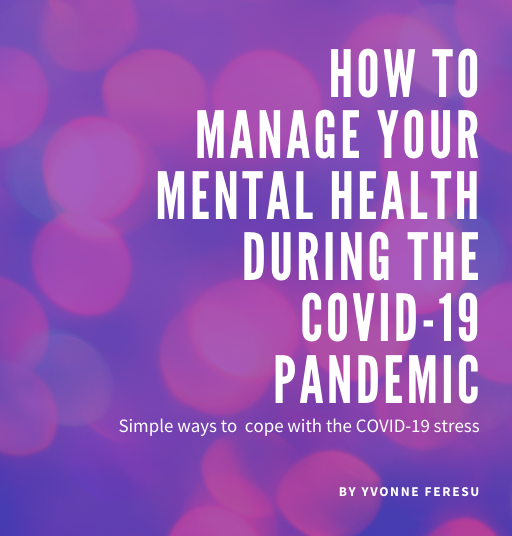
    I wrote my first e-book, finally! And it’s on mental health.

    This was no easy task! It showed me new levels of frustration, and I acquired a profound respect for cover and book designers. I seriously underestimated the editing and proofreading process. Editors deserve more money than they charge honestly, and I deserve a bottle of wine for my frustration bearing abilities.

    PS: In writing this e-book, I’m also smashing a resolution I made at the beginning of the year, promises I made myself.

    READ: My 2020 challenge – promises to myself.

    What’s the e-book about?

    Managing your mental health during a pandemic. When COVID-19 was first reported in Zimbabwe, up until the first fatality, my anxiety started running high. It was all anyone spoke about; at the office, at home, in public transport, on social media. I spent too much time keeping myself updated on every little piece of that was released onto the media. I was going crazy, and I was definitely overdoing it. Of course, when I started imagining everyone I knew who fit within the more ‘vulnerable groups’ inside a coffin, I realized I was taking it too far.

    That’s when I decided to make a conscious effort to protect my mental health. Coincidentally a group I’m part of (1k Challenge) put up an e-book writing competition. I didn’t enter the competition, but I did write an e-book, almost three times the length required by the competition. The directive was to write on something you know about, but that’s also useful to others. It occurred to me that perhaps I could document the actions I took to manage my fear about coronavirus. Hopefully, someone else would find it useful.

    Harder than it looks, but easier than I thought

    I have always toyed with the idea of writing a non-fiction e-book, but all my paltry attempts failed dismally…obviously. I wasn’t putting enough effort. I wasn’t being consistent, neither was showing any discipline. What I did terrifically was to dream about it, which I’ve always been good at. I knew writing a book would be difficult, every writer knows that (but most people don’t realize this). Writing a book is very challenging (I’m talking about 200-400 paged creations here). Writing a novel is an even more challenging endeavour.

    But …it’s easier than I imagined. Perhaps I underestimated my own abilities, but I wasn’t sure I could pull it off (despite working jobs that rely heavily on my writing skills). My e-book is only about 21 pages long, but I’m proud of it. It’s a good start and taught me quite a great deal about writing a manuscript. Without further ado, you can read or down it here.

    How I pulled it off

    • I wrote down all my major points in the numerical order they would appear in the e-book
    • Then I set a timeline (which I didn’t follow)
    • I collected my research
    • Came up with a distribution plan (which I’m loosely following)
    • Wrote first draft (I wrote about 500 words every day from 6.30-7am)
    • Edited and proofread (a ton of times, back and forth until I was ready to scream with frustration)
    • Designed my cover in Canva (I just edited a template, to be honest)
    • Put everything together in Google Docs and Smallpdf (this is the part that almost made me cry)
    • Published!
    • Then I saw more errors and had to take it down
    • More editing and proofreading and tears of frustration
    • Decided I didn’t want to anymore
    • More formatting and editing…then, published.

    Learning points

    Discipline is necessary. You have to be patient. It takes more time than you probably imagined. Frustration will have you aching to throw away your whole laptop. Try, try, and try again, until you’ve had it up to your neck.

    Did I mention patience? You need buckets of it, because a project like this, small as it is, will stretch your patience to breaking point.

    I can’t be more pleased about this, I really can’t explain to you how happy I am about my small victory. Poor Bae had to deal with my frustration also, but the encouragement went a long way to saving the e-book from the digital trashcan.

    PS: Share the e-book with anyone you think could really use it, or maybe even those who don’t know they could use it. He’s a link to it, again.

    https://bit.ly/how-to-manage-your-mental-health-during-the-COVID-19-pandemic-ebook

  • Why aren’t we doing more about the COVID-19 threat in Zimbabwe?

    Why aren’t we doing more about the COVID-19 threat in Zimbabwe?

    Are we waiting for a positive case before we take aggressive action?

    I’m scared. As a Zimbabwean citizen living in Zimbabwe, I’m scared. I’m afraid because we’re not taking the threat of coronavirus infections seriously enough. I’m worried because if we wait until we have confirmed cases, it’ll be too late. I listen to people marvel at what’s happening around the world, and in the same breathe dismiss the potential of it happening here. I’m afraid that as a people we’re not doing enough. Both the government and we, the citizens are not doing enough.

    Are we waiting for Africans to die before we become convinced that we’re at risk too?

    Must we wait to react instead of acting proactively?

    I hear people say all sorts of things about the virus, things that have no scientific basis. A lot of it makes sense, it really does. The theory that black people can’t die from COVID-19 seems believable, mostly because none of us have died yet. But think about it, what could possibly make us immune to COVID-19? What part of our DNA protects us from a respiratory disease? Are we willing to risk our lives, the loved ones, and the already battered economy on an untested assumption?

    I certainly am not.

    As of today, there are reported cases of black people contracting the virus. Remember when we thought cancer was for white people? And yet in 2019, according to the Ministry of Health and Child Care, cancer remains one of the major killers in Zimbabwe, health-wise (parlzim.gov). We said depression was a white man’s illness, and yet we all know someone who is suffering from depression or who did, or maybe we are that person. And now to think that COVID-19 affects all other races except ourselves is to be extremely arrogant and reckless. We have no basis for such an assumption. (Also Idris Elba tested positive, and last I checked, he’s black)

    So why haven’t there been any cases in Zimbabwe? And only a few in Africa?

    I don’t know, nobody has figured that out yet, but here’s what we know:

    • We’re not as connected to the rest of the world as, for example, Italy is…or China. Case in point, how many planes land at RGM International airport a day? Now consider how many flights land at Leonardo Da Vinci Intercontinental Airport in Rome? There’s no comparison there. (Not to say COVID-19 entered through that particular airport.)
    • Our warm climate means we are safe from COVID-19. Reports on how climate interacts with the virus are inconclusive. For argument’s sake, let’s go with the common belief that our warm climate is protecting us, and the African sun will kill the virus at first exposure…are we not heading for winter? The kind of weather that the virus, according to our premise, will thrive? In less than 3 months we’ll be right in the heart of winter. You can read the transcription of WHO officials discussing the weather question during a press conference.

    If you have more possible reasons you know, feel free to research how justifiable those assumptions are, but stance still stands. We need to do more as a nation. Our government could do more yes, but at the community level, there’s so much more we could do. I watch people breeze through doors of major supermarkets ignoring the hand sanitizers and wipes, and yet it these little things that could make a difference. The World Health Organisation has released guidelines that we could all do our best to follow, and you can find those here.

    What more could we do?

    • We could take initiative and state practising social distancing.
    • Limit the number of public gatherings we attend, e.g. weddings, funerals, church services, parties, concerts, trade fairs, national celebrations etc. (Social distancing is crucial for slowing the spread of the virus)
    • Stay at home more often.
    • Respect people’s personal space and keep a distance of at least a metre from the next person in public spaces.
    • Wash your hands with clean water and soap often, and when you cannot, use an alcohol-based sanitizer.
    • Avoid touching rails and surfaces in public spaces.
    • Limit physical contact to your family, and avoid shaking hands with people, (you can wave, nod, bow or just smile from a distance honestly).

    Understandably this is really difficult to do in Zimbabwe, for one, most of us have no access to running water, and when it does come, sometimes it comes out filthy. If you have ever travelled on a ZUPCO bus, then you know that keeping a distance from people is impossible. You can still do the most that you can. There is, of course, a part that the government should play, we can’t do this alone.

    Our transport industry needs to be addressed, but in the interim, there are other measures we could take, like banning large public gathering, which means suspending activities like the Independence Day celebrations, Zimbabwe International Trade Fair (ZITF), Harare International Festival of Arts (HIFA), rallies and sports games. As far as I’m concerned, even large church services should be banned, you don’t need 150 other people with you to commune with God.

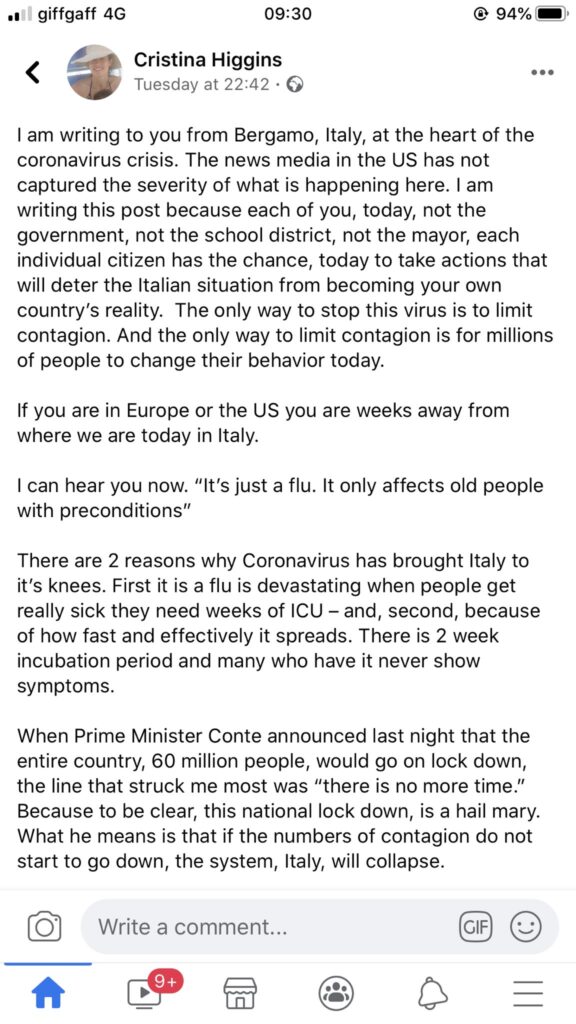
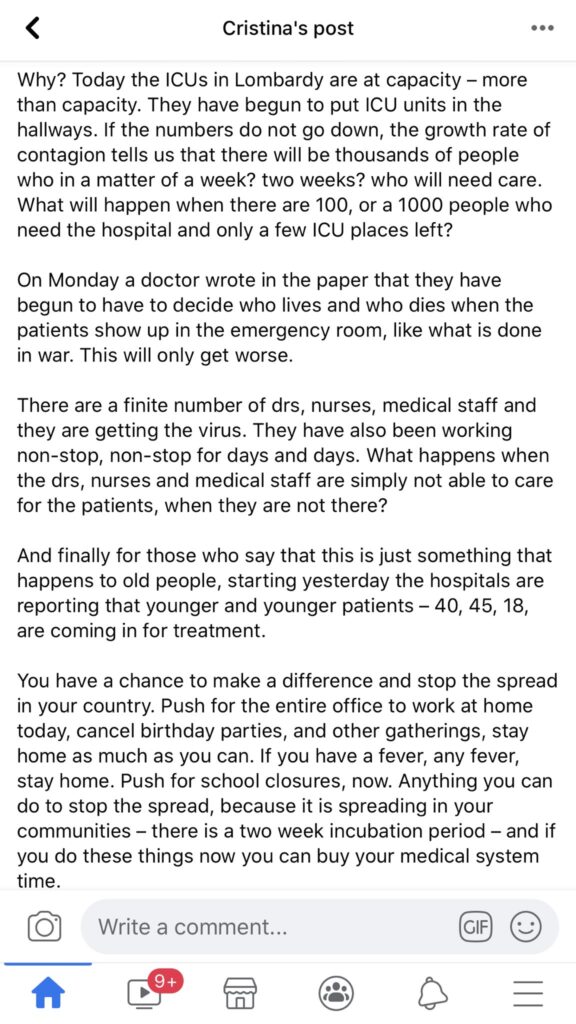
    We don’t need to experience it ourselves to learn from others. I read a letter from a woman in Italy, Bergamo, warning us, describing the situation in Italy and giving us a glimpse of how fast things could change. I’ve put up screenshots of her letter, or you can search Christina Higgins on Facebook, and you’ll see the story shared.

    If you won’t believe Christina, then perhaps this thread by @JasonYanowitz will convince you.

    I wanted to write more; more of what we could do, but I’ll do the next best thing. Here are several links to useful information about COVID-19. Read them, tell others, follow the guidelines and God willing we will scrape through this pandemic without too much damage; the alternative is unthinkable.

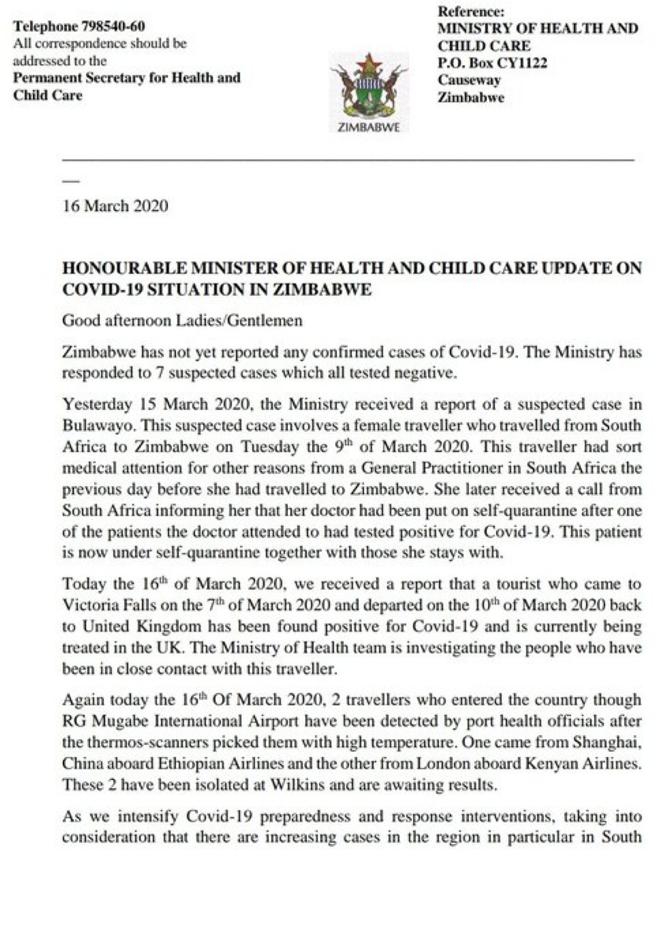
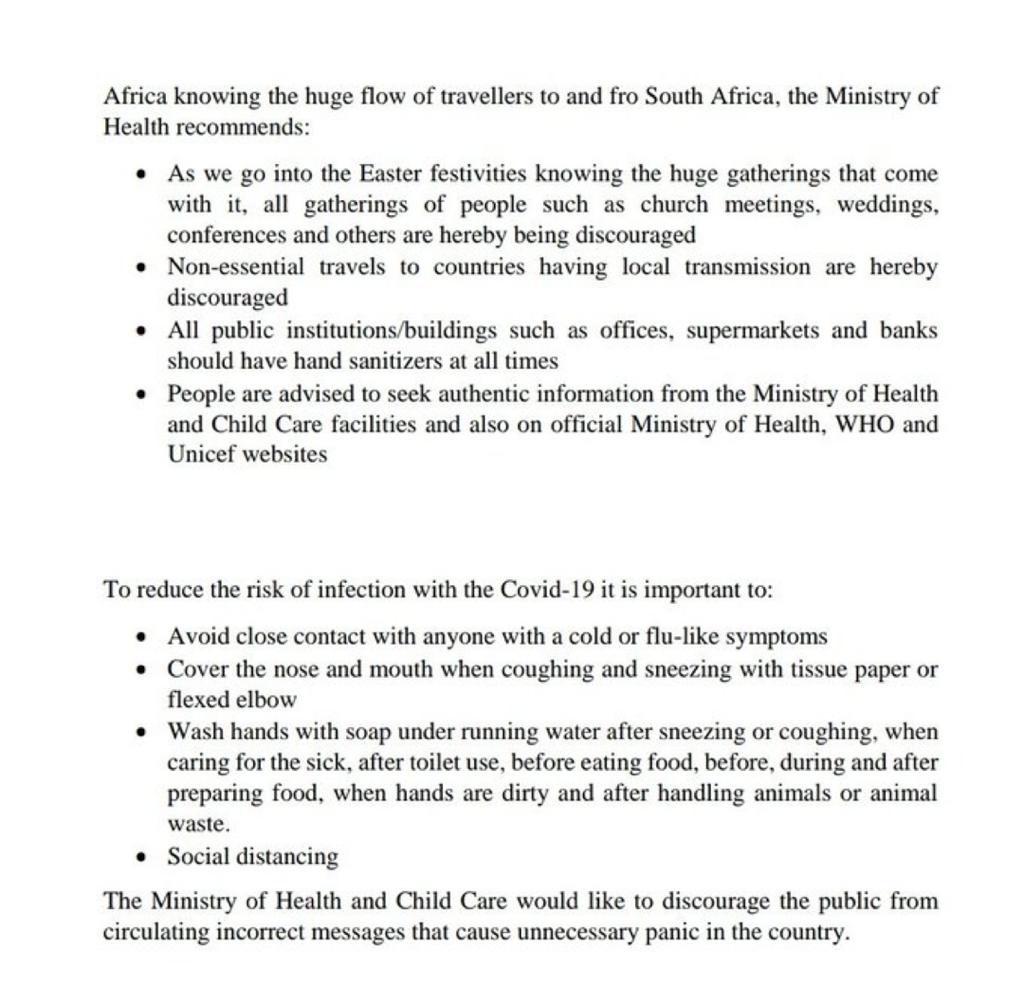
    The Ministry of Health and Child Care released a statement on the 16th of March, updating us on the situation. The time to act is NOW.

  • When friends die young: RIP Gathrie Shava

    When friends die young: RIP Gathrie Shava

    I remember the day I learnt that Gathrie had suffered a severe stroke. Having been off the grid for a while and almost unavailable, I was surprised when my sister asked me if I had heard the news. I thought, “Okay his career as an athlete is over, but it’s not the end of the world, he’s got a lot going for him. He’ll bounce back.”

    We discussed briefly what it would mean for him now after recovery, we talked about the after-effects of a stroke, and my sister, as a health professional, could probably envision better what his body would go through during and after his recovery. What we never considered was that he’d die days later. You never think your age-mate won’t make it beyond your years, and you certainly never expect a young healthy man to suffer a stroke.

    I’m not privy to what caused his stroke, my sister and I have our speculations, but that’s just guesswork. What I do know was that he lived his life to the fullest, and followed his dream. To readers who didn’t know him, this fellow was young, he was fit and he was a gentle soul. He worked hard in his pursuit of making it as a professional athlete, Track and Field.

    He was always good at it. From the day that we were in high school, his talent in the 400m races was evident, making him a star on the Track. Studying in the States was one of the best things that could have happened for his ambition in Athletics, it would have died here. Zimbabwe is not known for nurturing and growing its athletes their fullest capacities. Maybe he wouldn’t have been the next fastest man alive, but he would have lived his dream.

    Our history was a little messy, he was after all my high school sweetheart, and for the longest of time, our relationship was strained in the aftermath of its failure. But we made peace of some kind and I was happy to see him flourish. High school was not the kindest to him and I was glad to see him leave Zimbabwe, to start on a clean slate, make new friends and thrive in a new environment.

    My shock still hasn’t worn off entirely. We’re all worried about dying from COVID-19 but we forget that there are so many other things that could cut our lives short. It’s not fair that a young person dies. I’d have never thought in a million years (If I ever were to live that long) that he wouldn’t make it past his 25th birthday. As far as nature goes, we should all live long and die old, but that’s not the reality, that’s not the world we live in.

    My heart goes out to his family. His mother and his sister, I can’t begin to imagine the nightmare they’re living in right now, and the immense pain that will forever be part of their lives. I feel for his close friends, and the people who saw him daily and those he lived with it. My deepest condolences go out to them, their lives will never be the same.

    READ: Remembering that we’re not immortal and to live thus.

    No parent should ever bury their child. I hope his mother receives therapy; it won’t bring him back, neither will it erase the pain, but it will teach her how to live with it and how to cope with his loss.

    Gathrie’s death reminds those of us that knew him that you never know how long you have to live; that our mortality is very fragile. We are reminded to live every day in the present and to live life to the fullest. Love with your entire being, forgive others and yourself, make peace with those you wronged, keep in touch with your loved ones and always remember that our days here are numbered. He had so much zest for life, and undoubtedly he’ll always be remembered by those closest to him, and those whose lives he touched.

    Rest In Peace Gathrie Shava, aka “Switch”.

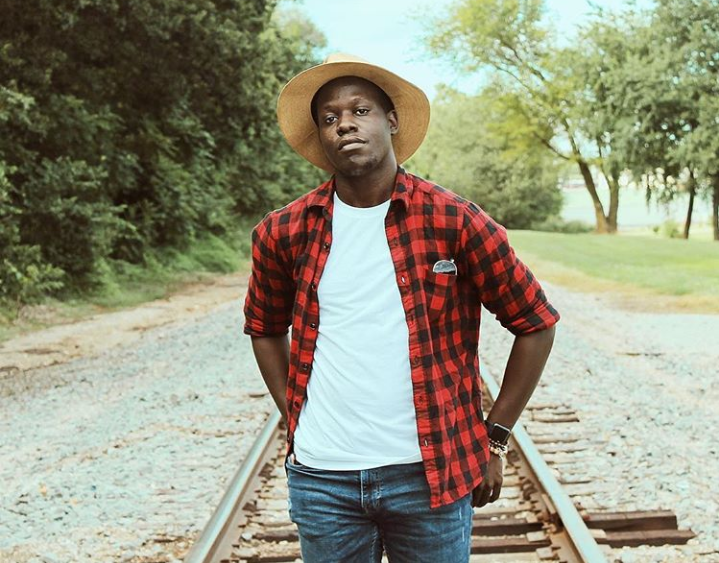
    Gathrie Shava
    Gathrie Gamuchira Shava, lived and loved from Jan 13, 1995 to Feb 29, 2020
    Photo cred: Gathrie Shava, Instagram
  • I applied for the Chevening scholarship and got rejected.

    I applied for the Chevening scholarship and got rejected.

    It was August 2019 and applications for the Chevening Award had just opened. This was my year, finally. With 2 years of work experience, a fairly clear career direction and powerful story I felt as if I was as ready as I was going to get. And so I started my application.

    (Side note: In case you didn’t follow the link above, Chevening is a full scholarship for international students to study for a master’s in the UK, at almost any university there.)

    I still remember the rush of excitement that came with planning. The dreams, the hopes…my imagination went to town, and for the first time since Athletics broke my heart, I let it. I didn’t do these applications alone, actually to be honest, it was Bae’s idea…and I went for it guns blazing.

    The sheer panic of possibly not meeting the deadline remains fresh in my mind. After starting my application at the beginning, my nemesis Procrastination paid a visit and I almost missed the deadline. I thanked my ancestors for the deadline extension, the only reason I managed to submit my application.

    Note to future applications: As the deadline approaches that portal will become problematic, because every other Yvonne around the world applying, will be attempting to complete her application and submit it on the last days too. Save yourself the trouble.

    The relief that came with submitting is hard to describe. I had done by part; it was out of my hands now. Of course, being the optimistic, over-enthusiast that I am, I went ahead and forked out the required $265 for the English proficiency test (which I aced by the way, I’m not ashamed to flaunt it). It was a necessary evil that I wanted to get out of the way as soon as possible.

    I didn’t stop there.

    I went ahead and secured myself an unconditional offer from City, University of London, which happened to be my first choice. Obviously I was thrilled…I was going to study Creative Writing and Publishing! Yes, sounds fancy I know. I had all my ducks in a row along with the positive attitude.

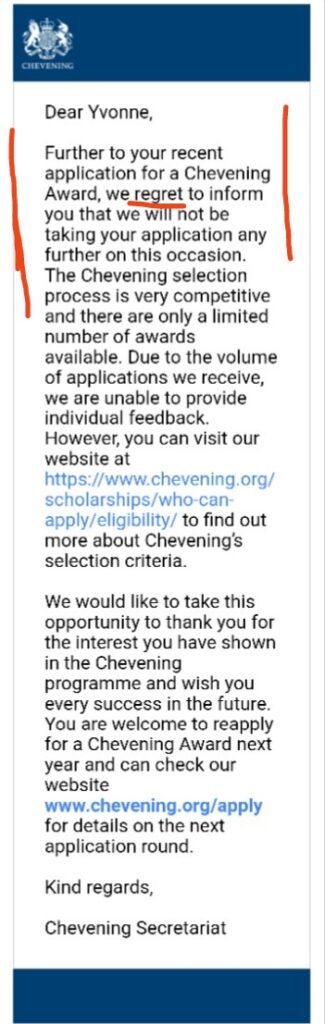
    The Chevening timeline is pretty straightforward. Applications close early November and the shortlist for interviews is ready for applications by early to mid Feb. How do you know you’re on it? You apparently receive an invitation to an interview, and you select your interview date. I say apparently because I didn’t receive it, I received the other one…the regret.

    I put the whole thing up there for more impact but obviously what’s between the red lines is the most important bit

    Now you can imagine the impatience I felt throughout the earlier days of February. I checked my email obsessively. I needed to know, am I one step closer, or am I moving on with my life. Turns out it’s the latter. I saw the email at work, during work hours. I badly needed 10 minutes in the bathroom to cry it out. There was no time (the life of a Comms Intern in a humanitarian organisation is really, really busy guys). I locked it down and walked around with my little bruised heart, getting work down.

    Now before you feel too much pity for me please know that disappointment is really nothing new to me. I’ve learnt to bounce back quickly. I’m constantly surprised when people say,

    “You always have stuff going for you!”

    Which is partially true, but mostly because I like to keep it moving.

    Rejection happens, even when we put our hearts and souls into something. Failure, rejection, disappointment are regular parts of life. Does it hurt? Yeah, it sucks big time but it happens… life happens. Accepting disappointment and finding the best way forward is the best way to protect your sanity and keep going.

    So what’s next for me? It back to the drawing board (I’m not applying again, once was enough). Did I have a plan B? Yes, but my Plan Bs usually require as much effort and commitment as Plan A, and second plans are subject to lots of revising. Wrapping your head around such a change in direction, of having a dream dashed takes some time. I refuse to put myself throw another gruelling process (because applying for that scholarship is) without giving myself time to re-coup.

    The silver lining

    There isn’t one…just kidding. I discovered hidden bits about myself I didn’t know through this application process. Writing 4 essays about your career plans, influence and leadership, your chosen field and your past will teach you a few things about yourself. Almost missing the deadline influenced how I picked my half-resolution for the year 2020, which is comfortably meeting deadlines, something which I historically suck at.

    Do I regret applying? Well…I make it a point not to regret decisions that I’ve made in the past. It’s pointless, I can’t change the past. Would I do it differently if I knew the outcome? Probably. I wouldn’t have bothered, but I did bother so that’s that. Obviously I do feel as if I wasted money on getting the IELTS, that’s money I’m never getting back, and a certificate I might never use because it’s only valid for 2 years. Perhaps, that’s the one thing I would change…I wouldn’t have written it before February.

    (Of course I could still have waited for an interview invitation, then still not have made it past the interviews themselves. Perhaps the best time, for you future applicant, is after receiving a conditional offer from Chevening. It’s a tight time crunch, but it’ll save you from wasting precious dollars.)

    All that being said, I’m bruised and smarting from the rejection, but we keep it moving. I will be okay. Good luck to fellow applicants who made it past this first screening, and best wishes to all future applicants.

    PS: I shouldn’t even have to say this, I mean it’s pretty obvious but all the opinions expressed here are my own, as well as experiences. I’m in no way affiliated to the Chevening Award.