Tag: COVID-19

  • Virus-anxiety: How I finally wrote my first ebook

    Virus-anxiety: How I finally wrote my first ebook

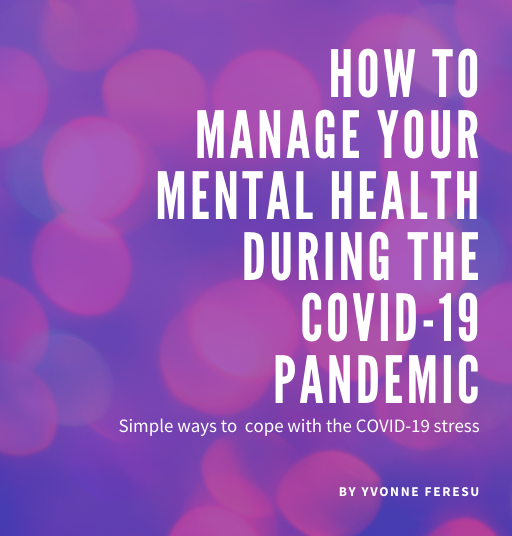
    I wrote my first e-book, finally! And it’s on mental health.

    This was no easy task! It showed me new levels of frustration, and I acquired a profound respect for cover and book designers. I seriously underestimated the editing and proofreading process. Editors deserve more money than they charge honestly, and I deserve a bottle of wine for my frustration bearing abilities.

    PS: In writing this e-book, I’m also smashing a resolution I made at the beginning of the year, promises I made myself.

    READ: My 2020 challenge – promises to myself.

    What’s the e-book about?

    Managing your mental health during a pandemic. When COVID-19 was first reported in Zimbabwe, up until the first fatality, my anxiety started running high. It was all anyone spoke about; at the office, at home, in public transport, on social media. I spent too much time keeping myself updated on every little piece of that was released onto the media. I was going crazy, and I was definitely overdoing it. Of course, when I started imagining everyone I knew who fit within the more ‘vulnerable groups’ inside a coffin, I realized I was taking it too far.

    That’s when I decided to make a conscious effort to protect my mental health. Coincidentally a group I’m part of (1k Challenge) put up an e-book writing competition. I didn’t enter the competition, but I did write an e-book, almost three times the length required by the competition. The directive was to write on something you know about, but that’s also useful to others. It occurred to me that perhaps I could document the actions I took to manage my fear about coronavirus. Hopefully, someone else would find it useful.

    Harder than it looks, but easier than I thought

    I have always toyed with the idea of writing a non-fiction e-book, but all my paltry attempts failed dismally…obviously. I wasn’t putting enough effort. I wasn’t being consistent, neither was showing any discipline. What I did terrifically was to dream about it, which I’ve always been good at. I knew writing a book would be difficult, every writer knows that (but most people don’t realize this). Writing a book is very challenging (I’m talking about 200-400 paged creations here). Writing a novel is an even more challenging endeavour.

    But …it’s easier than I imagined. Perhaps I underestimated my own abilities, but I wasn’t sure I could pull it off (despite working jobs that rely heavily on my writing skills). My e-book is only about 21 pages long, but I’m proud of it. It’s a good start and taught me quite a great deal about writing a manuscript. Without further ado, you can read or down it here.

    How I pulled it off

    • I wrote down all my major points in the numerical order they would appear in the e-book
    • Then I set a timeline (which I didn’t follow)
    • I collected my research
    • Came up with a distribution plan (which I’m loosely following)
    • Wrote first draft (I wrote about 500 words every day from 6.30-7am)
    • Edited and proofread (a ton of times, back and forth until I was ready to scream with frustration)
    • Designed my cover in Canva (I just edited a template, to be honest)
    • Put everything together in Google Docs and Smallpdf (this is the part that almost made me cry)
    • Published!
    • Then I saw more errors and had to take it down
    • More editing and proofreading and tears of frustration
    • Decided I didn’t want to anymore
    • More formatting and editing…then, published.

    Learning points

    Discipline is necessary. You have to be patient. It takes more time than you probably imagined. Frustration will have you aching to throw away your whole laptop. Try, try, and try again, until you’ve had it up to your neck.

    Did I mention patience? You need buckets of it, because a project like this, small as it is, will stretch your patience to breaking point.

    I can’t be more pleased about this, I really can’t explain to you how happy I am about my small victory. Poor Bae had to deal with my frustration also, but the encouragement went a long way to saving the e-book from the digital trashcan.

    PS: Share the e-book with anyone you think could really use it, or maybe even those who don’t know they could use it. He’s a link to it, again.

    https://bit.ly/how-to-manage-your-mental-health-during-the-COVID-19-pandemic-ebook

  • Why aren’t we doing more about the COVID-19 threat in Zimbabwe?

    Why aren’t we doing more about the COVID-19 threat in Zimbabwe?

    Are we waiting for a positive case before we take aggressive action?

    I’m scared. As a Zimbabwean citizen living in Zimbabwe, I’m scared. I’m afraid because we’re not taking the threat of coronavirus infections seriously enough. I’m worried because if we wait until we have confirmed cases, it’ll be too late. I listen to people marvel at what’s happening around the world, and in the same breathe dismiss the potential of it happening here. I’m afraid that as a people we’re not doing enough. Both the government and we, the citizens are not doing enough.

    Are we waiting for Africans to die before we become convinced that we’re at risk too?

    Must we wait to react instead of acting proactively?

    I hear people say all sorts of things about the virus, things that have no scientific basis. A lot of it makes sense, it really does. The theory that black people can’t die from COVID-19 seems believable, mostly because none of us have died yet. But think about it, what could possibly make us immune to COVID-19? What part of our DNA protects us from a respiratory disease? Are we willing to risk our lives, the loved ones, and the already battered economy on an untested assumption?

    I certainly am not.

    As of today, there are reported cases of black people contracting the virus. Remember when we thought cancer was for white people? And yet in 2019, according to the Ministry of Health and Child Care, cancer remains one of the major killers in Zimbabwe, health-wise (parlzim.gov). We said depression was a white man’s illness, and yet we all know someone who is suffering from depression or who did, or maybe we are that person. And now to think that COVID-19 affects all other races except ourselves is to be extremely arrogant and reckless. We have no basis for such an assumption. (Also Idris Elba tested positive, and last I checked, he’s black)

    So why haven’t there been any cases in Zimbabwe? And only a few in Africa?

    I don’t know, nobody has figured that out yet, but here’s what we know:

    • We’re not as connected to the rest of the world as, for example, Italy is…or China. Case in point, how many planes land at RGM International airport a day? Now consider how many flights land at Leonardo Da Vinci Intercontinental Airport in Rome? There’s no comparison there. (Not to say COVID-19 entered through that particular airport.)
    • Our warm climate means we are safe from COVID-19. Reports on how climate interacts with the virus are inconclusive. For argument’s sake, let’s go with the common belief that our warm climate is protecting us, and the African sun will kill the virus at first exposure…are we not heading for winter? The kind of weather that the virus, according to our premise, will thrive? In less than 3 months we’ll be right in the heart of winter. You can read the transcription of WHO officials discussing the weather question during a press conference.

    If you have more possible reasons you know, feel free to research how justifiable those assumptions are, but stance still stands. We need to do more as a nation. Our government could do more yes, but at the community level, there’s so much more we could do. I watch people breeze through doors of major supermarkets ignoring the hand sanitizers and wipes, and yet it these little things that could make a difference. The World Health Organisation has released guidelines that we could all do our best to follow, and you can find those here.

    What more could we do?

    • We could take initiative and state practising social distancing.
    • Limit the number of public gatherings we attend, e.g. weddings, funerals, church services, parties, concerts, trade fairs, national celebrations etc. (Social distancing is crucial for slowing the spread of the virus)
    • Stay at home more often.
    • Respect people’s personal space and keep a distance of at least a metre from the next person in public spaces.
    • Wash your hands with clean water and soap often, and when you cannot, use an alcohol-based sanitizer.
    • Avoid touching rails and surfaces in public spaces.
    • Limit physical contact to your family, and avoid shaking hands with people, (you can wave, nod, bow or just smile from a distance honestly).

    Understandably this is really difficult to do in Zimbabwe, for one, most of us have no access to running water, and when it does come, sometimes it comes out filthy. If you have ever travelled on a ZUPCO bus, then you know that keeping a distance from people is impossible. You can still do the most that you can. There is, of course, a part that the government should play, we can’t do this alone.

    Our transport industry needs to be addressed, but in the interim, there are other measures we could take, like banning large public gathering, which means suspending activities like the Independence Day celebrations, Zimbabwe International Trade Fair (ZITF), Harare International Festival of Arts (HIFA), rallies and sports games. As far as I’m concerned, even large church services should be banned, you don’t need 150 other people with you to commune with God.

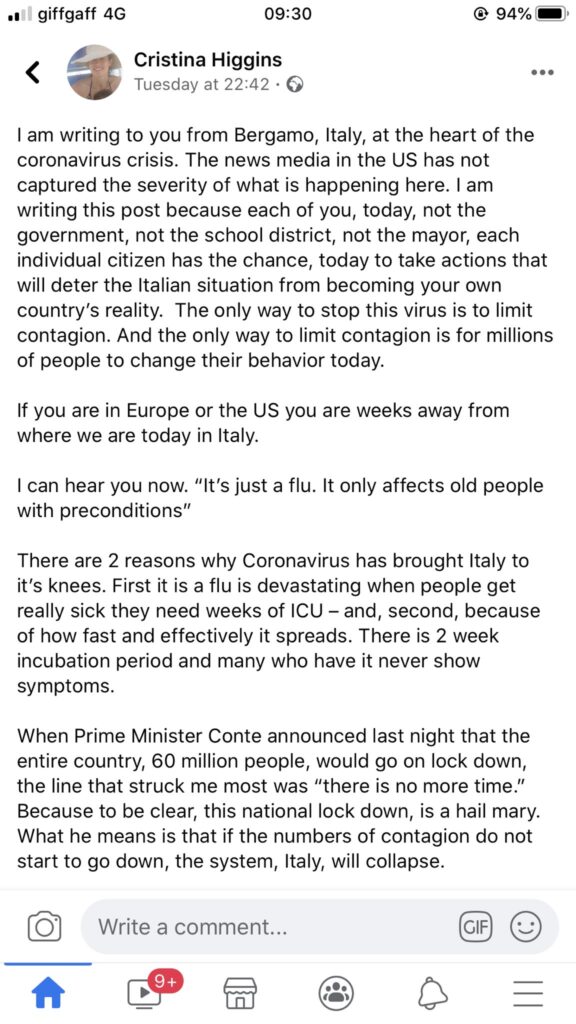
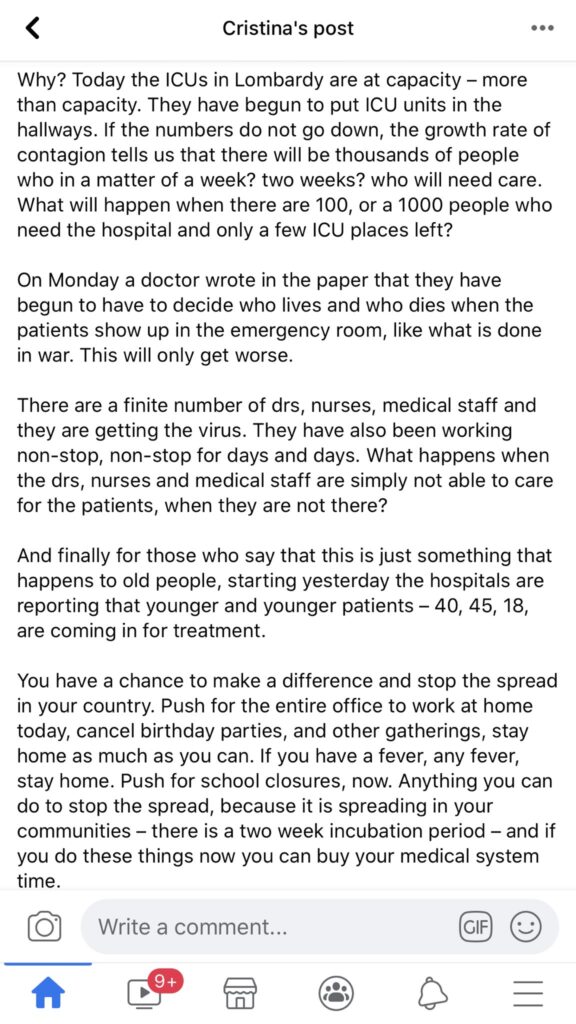
    We don’t need to experience it ourselves to learn from others. I read a letter from a woman in Italy, Bergamo, warning us, describing the situation in Italy and giving us a glimpse of how fast things could change. I’ve put up screenshots of her letter, or you can search Christina Higgins on Facebook, and you’ll see the story shared.

    If you won’t believe Christina, then perhaps this thread by @JasonYanowitz will convince you.

    I wanted to write more; more of what we could do, but I’ll do the next best thing. Here are several links to useful information about COVID-19. Read them, tell others, follow the guidelines and God willing we will scrape through this pandemic without too much damage; the alternative is unthinkable.

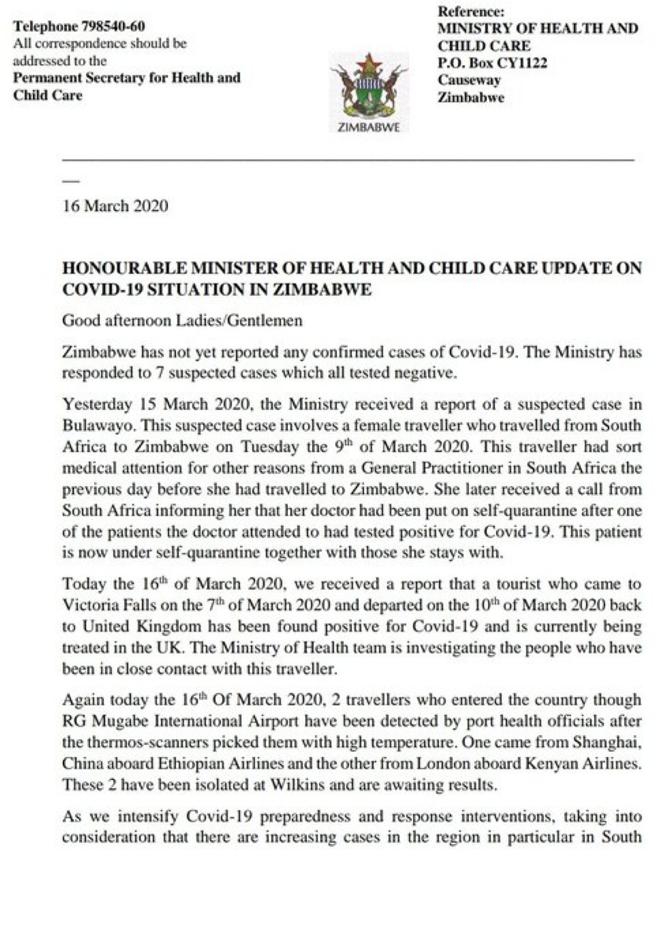
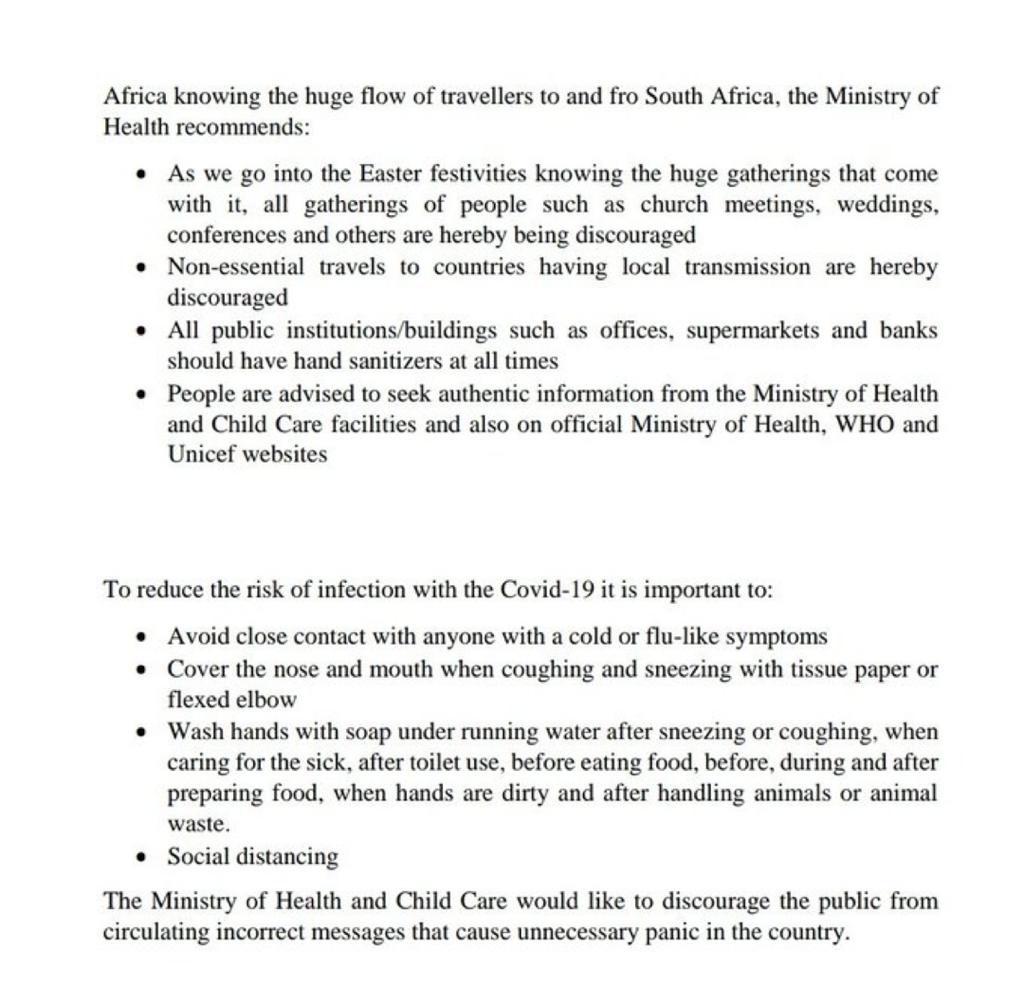
    The Ministry of Health and Child Care released a statement on the 16th of March, updating us on the situation. The time to act is NOW.